 Support US
Read Who Made Me a Princess? Manga Online
Aru Hi, Ohime-sama ni Natte Shimatta Ken ni Tsuite, Athanasia - Plötzlich Prinzessin, Bỗng một ngày tôi trở thành công chúa, De repente me convertí en una princesa, Dites-moi, Princesse!, Dzień, w którym zostałam księżniczką, Eoneu Nal Gongjuga Doeeobeoryeotda, Mo Fa Gong Zhu De Xiao Fan Nao, Mofa Gongzhu De Xiao Fannao, Nasıl Prenses Oldum, One Day I Became a Princess, One Day, I Became a Princess, Princesa encantadora, Suddenly Became a Princess One Day, Suddenly, I Became a Princess, Un dia me converti en una princesa, Wer hat mich zur Prinzessin gemacht?, Who Made Me a Princess, Намайг гүнж болгосон нэгэн, Однажды я стала принцессой, Одного разу я стала принцесою, من جعلني أميرة, ناگهان یک روز تبدیل به یک پرنسس شدم, อยู่มาวันหนึ่ง ฉันก็กลายเป็นเจ้าหญิง, อยู่ๆ ฉันก็กลายเป็นเจ้าหญิง, ある日、お姫様になってしまった件について, 某天成为公主, 某天成為公主, 魔法公主的小烦恼, 어느 날 공주가 되어버렸다
Synposis:
The story of Athanasia, forsaken princess of the Obelian Empire, ends with her execution at the hands of her own father. Except, did it? Her tragic tale is the plot of the novel The Lovely Princess. But now, a modern woman who has read the book has just woken up as baby Athanasia herself, filled wit
Type: Manhwa
Status: completed
Author(s): Plutus
Artist(s): Spoon
Released: 2017
Who Made Me a Princess? Chapters
Chapters Not Published Yet
Who Made Me a Princess?
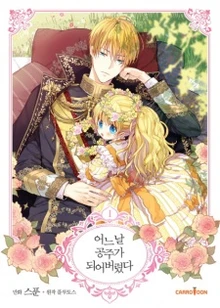
Who Made Me a Princess? (Korean: 어느 날 공주가 되어버렸다; Revised Romanization: Eoneu Nal Gongjuga Doeeobeoryeotda, also known as Suddenly Became a Princess One Day) is a landmark South Korean fantasy romance webtoon adapted by Spoon (illustrator) from the original web novel written by Plutus. Serialized by Carrotoon and D&C Webtoon Biz on platforms such as KakaoPage and RIDI from December 20, 2017, to April 30, 2022, the main manhwa adaptation concluded with 125 chapters across three completed seasons. Positioned at the forefront of the rofan (romance fantasy) and otome isekai subgenres, the series transcends standard reincarnation tropes through intricate political intrigue, paternal psychological drama, and high-fantasy magic systems.
While the initial hook centers on a modern Korean woman waking up inside the body of Athanasia de Alger Obelia—a neglected imperial princess fated to be executed by her cold-blooded father at age eighteen—the narrative quickly evolves beyond simple survival comedy. What begins as a desperate bid to hoard gold and escape the Ruby Palace transforms into a multi-layered saga about generational trauma, suppressed memories, dark magic, and the legitimacy of imperial succession within the Obelian Empire.
Latest Who Made Me a Princess? Updates & Serialization Status
The primary webtoon serialization of Who Made Me a Princess? officially concluded on April 30, 2022, with Chapter 125 serving as the main series finale. Following the conclusion of the main story, Spoon released special epilogue and side-story illustrations, while physical print editions—published in South Korea by Carrotoon and licensed in English by Seven Seas Entertainment—continue to roll out in full-color collector’s volumes.
Beyond the webtoon and Plutus’s completed 2015–2016 web novel (comprising 163 chapters plus side stories), the franchise expanded significantly into animation. Produced by the Chinese animation studio Colored Pencil Animation Design in collaboration with iQIYI and Crunchyroll, the donghua/anime adaptation premiered in 2025, bringing the Obelian Empire’s ornate European-inspired aesthetic to global streaming audiences and driving a massive resurgence in readership across digital platforms.
Story Overview & Core Narrative Arcs
The narrative follows Athanasia de Alger Obelia, who retains the memories of her past life in modern South Korea alongside knowledge of The Lovely Princess, the fictional romance novel she now inhabits. In the original book, Athanasia is framed for poisoning her half-sister, Jennette Margarita, and is mercilessly executed by her father, Emperor Claude de Alger Obelia. Determined to rewrite her fate, Athanasia initially adopts a “Plan A” strategy of accumulating wealth to flee the empire before her eighteenth birthday, only for an accidental encounter with Claude at age five to derail her quiet life and force her into the perilous center of court politics.
-
The Ruby Palace Survival Arc: Young Athanasia navigates extreme neglect under the watchful eye of her loyal maid, Lilian York, attempting to remain invisible while stockpiling jewels for an eventual escape.
-
The Emperor’s Awakening: Following an unexpected meeting in the palace gardens, Claude takes an uncharacteristic interest in Athanasia, forcing her to perform survival diplomacy while slowly thawing his emotional detachment.
-
The Mana Explosion & Awakening: Athanasia’s dormant, overwhelming royal mana violently erupts, leading to her formal partnership with Lucas, the enigmatic Magician of the Black Tower, who helps stabilize her volatile magical core.
-
The Amnesia & Anastacius Conspiracy: After Claude suffers a catastrophic magical backlash triggered by black magic, he loses all memories of Athanasia, plunging the empire into a succession crisis orchestrated by his resurrected brother, Anastacius, and the Duke of Alpheus.
-
The Final Reckoning of the Obelian Bloodline: Athanasia steps fully into her role as Crown Princess regent, uniting allies across noble houses to purge the corrupting black magic threatening both Claude’s life and the stability of the realm.
Main Characters in Who Made Me a Princess?
-
Athanasia de Alger Obelia: The reincarnated protagonist who balances sharp, pragmatic modern instincts with genuine emotional vulnerability. Initially driven purely by self-preservation, Athanasia evolves from a terrified child performing affection for survival into a poised, compassionate ruler willing to risk her own life to save the father she genuinely comes to love.
-
Claude de Alger Obelia: The reigning Emperor of Obelia and the central source of both existential dread and emotional anchor in the series. Haunted by the death of his beloved consort Diana, Claude sealed away his emotions using forbidden black magic—a decision that turned him into a ruthless tyrant while slowly poisoning his own mind and body.
-
Lucas: The aloof, centuries-old Magician of the Black Tower who serves as Athanasia’s magical mentor, bodyguard, and primary love interest. Possessing near-godlike arcane mastery, Lucas initially views Athanasia as a curious anomaly due to her massive mana reserves, gradually developing fierce loyalty toward her as she challenges his detached worldview.
-
Jennette Margarita: The biological daughter of former Emperor Anastacius and Penelope Judith, raised by Duke Roger Alpheus as a political pawn to usurp the throne. Rather than a malicious rival, Jennette is depicted with tragic nuance—a lonely girl desperate for family warmth whose very existence is entwined with dark magic.
-
Anastacius de Alger Obelia & Aeternitas: Claude’s older brother and former emperor, whose body is possessed by the vengeful spirit of Aeternitas, a past Obelian ruler. Together with the manipulative Duke Alpheus, they represent the overarching political and arcane threat seeking to destabilize the crown from within.
Lore, Power Systems, and World Mechanics
Magic in the Obelian Empire is strictly hereditary, tied directly to the imperial bloodline and distinguishable by the signature jeweled blue eyes possessed exclusively by members of the royal family. Mana acts not merely as an offensive tool, but as an internal life-force that must be regulated; when a royal inherits an excessive concentration of mana without proper training, it manifests as a fatal mana explosion.
-
Imperial Jeweled Eyes: The physical hallmark of pure Obelian royalty, glowing with luminescent blue radiance that intensifies when channeling high-tier mana.
-
The Black Tower: An autonomous, ancient institution housing the empire’s greatest mages, operating largely independent of the crown’s political authority.
-
Divine Beasts & Familiar Bonds: High-level mana users can manifest sentient familiars—such as Athanasia’s mana-beast, Raven—which absorb excess magical energy to prevent internal combustion.
-
Forbidden Black Magic: A parasitic, soul-eroding arcane art capable of suppressing human emotions, resurrecting the dead, and creating artificial lifeforms (such as chimera-like homunculi), at the cost of progressive neurological decay.
Underpinning the empire’s lore is the Curse of the Obelian Throne, a generational cycle of fratricide and emotional repression fueled by ancient black magic. Past emperors, particularly Aeternitas, utilized forbidden rituals to cling to power beyond death, creating a historical pattern where rulers sacrifice their humanity to maintain absolute sovereignty.
Narrative Framework & Progression Appeal
Who Made Me a Princess? sustains long-term reader engagement by shifting the goalpost from physical survival to emotional restoration and political legitimacy. Rather than relying on rapid power-ups, the series treats relationships and memory as fragile, hard-won assets that can be stripped away in a single chapter.
-
Asymmetric Information Tension: Athanasia’s foreknowledge of The Lovely Princess gives her an early strategic edge, which systematically erodes as her actions butterfly-effect the timeline into uncharted territory.
-
The Ticking Time Bomb Mechanic: Claude’s dark magic curse functions as a persistent biological countdown, ensuring that even peaceful slice-of-life chapters carry underlying dread.
-
Dual-Track Stakes: Domestic intimacy inside the Emerald Palace is constantly juxtaposed against high-stakes aristocratic scheming led by the Alpheus faction.
-
Earned Emotional Catharsis: Claude’s gradual transition from a stoic executioner to an overprotective father is paced across dozens of chapters, making his eventual amnesia arc devastating for readers.
-
Visual Foreshadowing: Spoon embeds subtle clues—such as wilting flowers, shifting eye luminescence, and spatial framing—that reward attentive readers tracking the progression of Claude’s curse.
Franchise Identity & Production Quality
Artist Spoon’s visual direction established a gold standard for the modern romance fantasy webtoon industry. Moving away from utilitarian paneling, the series utilizes lavish vertical scroll compositions, watercolor-inspired lighting, and bespoke couture fashion designs that change from chapter to chapter.
-
Signature Couture & World Design: Athanasia’s wardrobe evolves visually alongside her status, transitioning from simple Ruby Palace dresses to intricate imperial gowns reflecting European Rococo and Victorian influences.
-
Expressive Color Theory: Warm golds and pastel pinks dominate scenes of genuine familial warmth, abruptly shifting to cold silvers, deep shadows, and harsh crimson during moments of political danger.
-
Pacing Mastery: Extended silent panels allow emotional beats—particularly between Claude and Athanasia—to breathe without over-reliance on internal monologue.
-
Faithful Adaptation Discipline: Spoon streamlined pacing bottlenecks from Plutus’s original novel while expanding visual characterization for supporting figures like Felix Robane and Lilian York.
-
Cross-Media Visual Consistency: The distinct character silhouettes and jeweled-eye motifs translated seamlessly into merchandise, artbooks, and the subsequent animated adaptation.
Setting & Societal Impact
The Obelian Empire is structured as an absolute monarchy where magical supremacy directly reinforces feudal hierarchy. Political power is concentrated within the Imperial Palace—divided into distinct residences such as the Garnet, Emerald, and Ruby Palaces—while noble houses compete for proximity to the crown through arranged marriages and debutante balls.
-
Palace Spatial Hierarchy: Where a royal resides signals their exact political standing; the dilapidated Ruby Palace serves as a gilded prison for disfavored consorts and forgotten heirs.
-
The Debutante Tradition: A pivotal societal rite of passage where noble daughters formally enter high society, functioning as a public arena for factions to test imperial favor.
-
Aristocratic Factionalism: Houses like Alpheus leverage wealth, adoptive heirs, and administrative influence to counterbalance the emperor’s absolute magical authority.
-
Commoner-Noble Divide: Magic remains overwhelmingly monopolized by royalty and high nobility, leaving ordinary citizens dependent on imperial stability to avoid civil war.
-
Diplomatic Isolation: Neighboring kingdoms view Obelia with cautious reverence due to the overwhelming destructive capacity of the emperor’s mana.
Why Who Made Me a Princess? Is So Popular
-
Subversion of the “Villainess” Formula: Instead of framing Jennette as a one-dimensional schemer, the story humanizes both princesses, turning potential rivalry into a tragic exploration of fabricated family bonds.
-
Unmatched Art Direction: Spoon’s luminous illustration style became one of the most imitated aesthetics in the global webtoon ecosystem, setting industry benchmarks for fantasy romance.
-
Complex Father-Daughter Dynamics: By centering the emotional core on paternal redemption rather than solely romantic courtship, the series appealed to a broader demographic than standard romance titles.
-
High-Stakes Amnesia Arc: The mid-series memory loss storyline subverted reader expectations by forcing Athanasia to stand independently as a leader rather than relying on Claude’s protection.
-
Global Accessibility & Merchandising: Early official translations on Tapas and Tappytoon, paired with deluxe print editions and an anime adaptation, created sustained multi-year momentum across international markets.
Where to Read Who Made Me a Princess? Officially
-
Tapas (English Digital): Hosts the complete 125-chapter official English webtoon serialization.
-
Tappytoon (English Digital): Offers the full official English digital release alongside bonus illustrations.
-
KakaoPage & RIDI (Korean Original): The primary South Korean digital platforms hosting both the original webtoon and Plutus’s complete source web novel.
-
Seven Seas Entertainment (English Print): Publishes the official full-color physical paperback editions in North America and international markets.
Final Thoughts
Who Made Me a Princess? stands as a foundational pillar of the global webtoon boom, demonstrating how emotionally resonant character writing and museum-grade digital illustration can elevate familiar reincarnation tropes into enduring modern classics. By anchoring its high-fantasy world-building in the fragile psychology of memory, grief, and chosen family, Plutus and Spoon crafted a narrative that resonates long after its final chapter.
With the main webtoon complete, physical collector’s volumes continuing to reach international bookshelves, and the animated adaptation introducing the Obelian Empire to a new wave of viewers, the franchise’s legacy remains secure as the definitive benchmark for fantasy romance manhwa.